
How Pipe Bursting Sewer Line Replacement Works in Gold Coast
Ever freaked out at the thought of your Gold Coast backyard being ripped up for a busted sewer? Picture a quiet weekend morning: you haven’t even had your flat white yet, and suddenly there’s a giant trench slicing through your pristine lawn. I’ve seen it happen, and trust me, it doesn’t make for a relaxing day.
That’s exactly why pipe bursting sewer line replacement is such a game-changer. For context, the City of Gold Coast has a Sewer Relining Program page featuring trenchless sewer upgrades across the city. In plain terms, pipe bursting sewer line replacement is just a clever way to replace an old sewer line without bulldozing your yard.
What is Pipe Bursting Sewer Line Replacement?
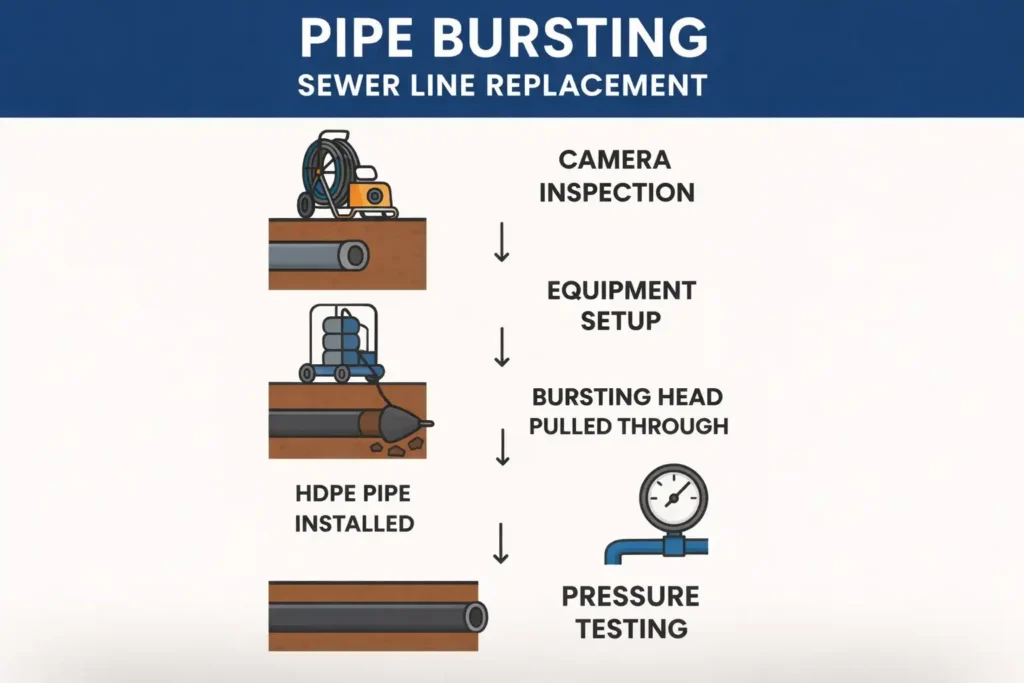
Put simply, pipe bursting sewer line replacement is a trenchless repair technique for sewers. A specialized bursting head (a cone-shaped tool) is pulled through the old pipe, crushing it outward while dragging a new HDPE pipe in behind it. If your original pipe was like a brittle chocolate shell, the bursting head shatters it and leaves a fresh “Hershey” in place – the brand-new polyethylene pipe.
This all happens underground, so there’s no need for a bulldozer to obliterate your driveway. In practice, that phrase might sound like jargon, but it literally means you get a brand-new sewer line with almost no digging. It’s like plumbing’s answer to magic – out with the old and in with the new, all hidden from view.
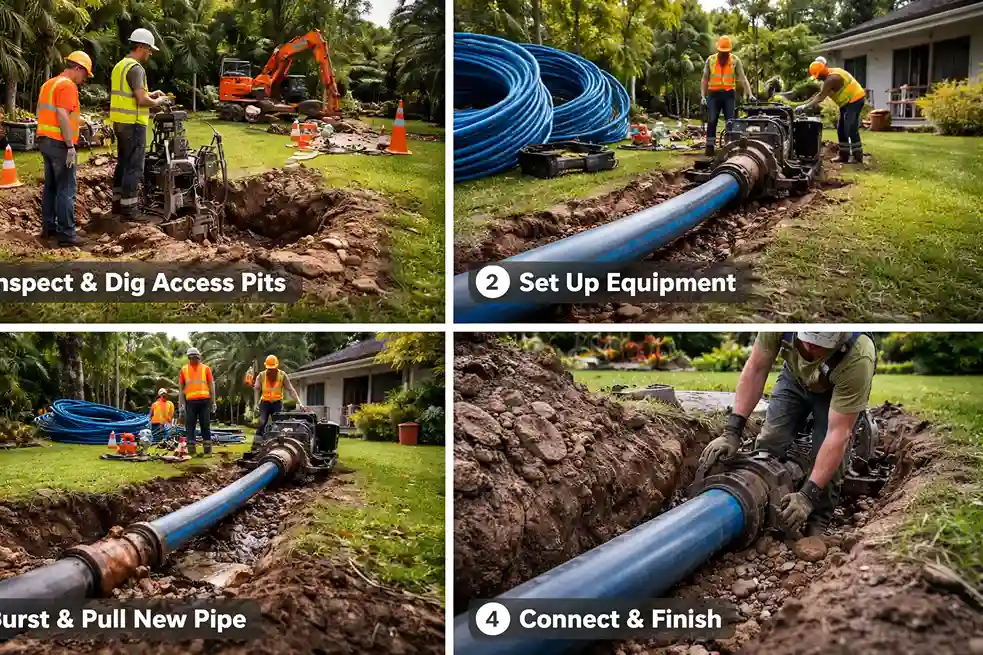
How Pipe Bursting Sewer Line Replacement Works
The process unfolds in a few clear steps:
Prepare & inspect:
Two small holes (pits) are dug at each end of the damaged pipe (often one at your house and one at the street). The crew runs a camera inspection to map out the old line. Bypass pumps keep sewage flowing around the work.
Set up equipment:
Above ground, technicians heat-fuse sections of HDPE pipe into one continuous new line. The bursting head is bolted to the front of this new pipe.
Burst and pull:
A hydraulic machine then pulls the bursting head through the old pipe. As it moves, it cracks and pushes aside the old pipe material while simultaneously dragging the new HDPE pipe into place. Think of it as a subterranean piñata – old pipe fragments fly out of the way as the new pipe takes its place.
Tie in & finish:
Once the head reaches the far pit, plumbers connect the new pipe to your home’s plumbing and the main sewer. They pressure-test the line, refit any fittings, and then fill the pits.
Benefits of Pipe Bursting Sewer Line Replacement
Why all the fuss about pipe bursting? For Gold Coast homeowners (and tradies like me), the advantages are huge:
- Minimal digging: Only two small access pits instead of a long trench, so your trees, lawn and driveway stay untouched.
- Fast installation: Projects often wrap up in a day or two – typically 4–5× faster than open-cut digging.
- Pipe upsizing: You can often increase the diameter during replacement (e.g. go from 150mm to 200mm pipe) to boost flow.
- Joint-free new pipe: The replacement is a single, fused HDPE pipe (no joints to leak). It resists root intrusion and corrosion, usually rated for 50–100 years.
- Less disruption: No long-term road closures, jackhammer noise or mountains of dirt. Trenchless bursting cuts down on traffic detours and emissions compared to digging.
All of this translates to serious savings. You avoid expensive landscaping repairs and get your sewer fixed much quicker. The EPA even notes that trenchless rehab like bursting greatly reduces the work area, traffic disruptions and environmental impact. In sensitive areas (think Gold Coast creeks or parklands), a trenchless upgrade can be the only viable option.
One of the biggest advantages of pipe bursting sewer line replacement is how little it disturbs the surface. Unlike traditional trenching, this trenchless method protects landscaping, roads, and nearby structures.
In fact, the U.S. Environmental Protection Agency recognises pipe bursting as a sustainable water infrastructure solution because it significantly reduces excavation, material waste, and restoration work.
| Advantages | Disadvantages |
| Minimal excavation: Only two small pits needed | Flow bypass required: Sewage must be rerouted or pumped around the site |
| Fast install: Often completed in 1–3 days | Soil limits: Not ideal for very rocky, sandy, or flooded soils |
| Upsizing possible: Can increase pipe diameter during replacement | Access space: Needs room at each end for machinery and bursting cable |
| Durable new pipe: HDPE is joint-free (no leaks) and corrosion-proof | Ground movement: Shallow pipes can cause surface heave or settling when burst |
Pipe Bursting Sewer Line Replacement vs Other Methods
How does pipe bursting stack up against traditional fixes? With open-cut replacement, you dig a trench along the entire pipe and rip it out – a guaranteed long road closure and landscaping mess. With pipe bursting sewer line replacement, the job is done through tiny holes.
There’s also pipe relining: you pull a new liner into the old pipe to seal cracks. That can work if the pipe is mostly intact, but it won’t fix a collapsed or broken line, and you can’t upsize. Pipe bursting, on the other hand, completely removes the old pipe and installs a fresh one.
In other words, bursting takes out the old line (like pulling out a bad tooth) and replaces it, whereas relining simply grafts a new lining inside the old skeleton. As Roto-Rooter puts it, trenchless pipe bursting “doesn’t require digging trenches” – it just breaks up the old pipe underground and pulls in a new one.
Summary of options:
- Open-trench dig: Max disruption, slower, plus huge restoration costs.
- Pipe relining: No trenches, but only for minor damage (no upsizing, can’t fix a hole).
- Pipe bursting: Trenchless plus upsizing, suited for severe damage, with only two small digs.
For Gold Coast homes, many pros consider bursting the “surgical” option of the bunch. It’s the difference between using a scalpel versus a jackhammer. If your pipe is under a patio or pool, bursting usually wins because your yard ends up exactly how it started.
When to Choose Pipe Bursting Sewer Line Replacement
When is pipe bursting the right choice? According to plumbing experts, it’s ideal if you have:
- A collapsed, crushed, or heavily corroded pipe – basically one that’s shot and can’t be relined.
- An outdated pipe material like old clay, cast iron or Orangeburg that won’t hold up.
- Paved or landscaped areas above the pipe (driveways, lawns, sidewalks) where you don’t want to dig a trench.
- A need to upsize the pipe for better flow – bursting can often add 25–50% more diameter.
- A tight timeline or space: pipe bursting finishes fast and only needs two holes, not room for a full trench.
In short, if tearing up your yard is a non-starter, pipe bursting sewer line replacement is designed to save the day. (If your pipe is just a little cracked, simple relining or patching might suffice; bursting is for the really tough cases.)
Pipe Bursting Sewer Line Replacement in the Gold Coast
The Gold Coast’s climate and soil give a local flavor to sewer issues. We’ve got sandy, sometimes corrosive ground, and a booming urban area – so reliable pipes are a must. In one recent case, city engineers found that a major sewer burst was caused by “aggressive” soils corroding an old pipe. Bursting swaps in corrosion-resistant HDPE, fixing that problem for decades.
We also have to think about surfers and stock trucks: the city can’t afford big roadworks every time a pipe leaks near Surfers Paradise. This is why local authorities love trenchless fixes. In fact, a Gold Coast infrastructure case study describes using trenchless methods to install large new HDPE mains under waterways (like the Nerang River) so beaches and traffic stayed undisturbed.
For you and me, that means less noise and detours. Gold Coast Council’s own sewer programs now emphasize no-dig upgrades. Essentially, pipe bursting sewer line replacement fits right into our laid-back lifestyle – your pipe gets fixed while you keep your yard exactly how it was.
Conclusion
Pipe bursting sewer line replacement really feels like plumbing magic on the Gold Coast. It delivers a brand-new sewer line in days and lets you keep your garden in one piece. We’ve covered the how-to, the big advantages (and a few caveats), and why it makes sense in Aussie conditions. If your property’s sewer is on its last legs, it’s definitely worth talking to a trenchless plumbing pro. You’ll save on landscaping headaches and have a beefy new pipe that lasts decades.
Next time a tradie mentions pipe bursting sewer line replacement, you’ll know it means a fast, garden-friendly fix. For Gold Coast residents, it’s pretty much our new favourite way to replace old sewers. So skip the big trenches and get ready to enjoy your yard with zero (or minimal) disturbance.
If you’re dealing with underground plumbing issues and want a solution that won’t tear up your property, it’s worth exploring professional plumbing services designed for modern homes.

No Comments